

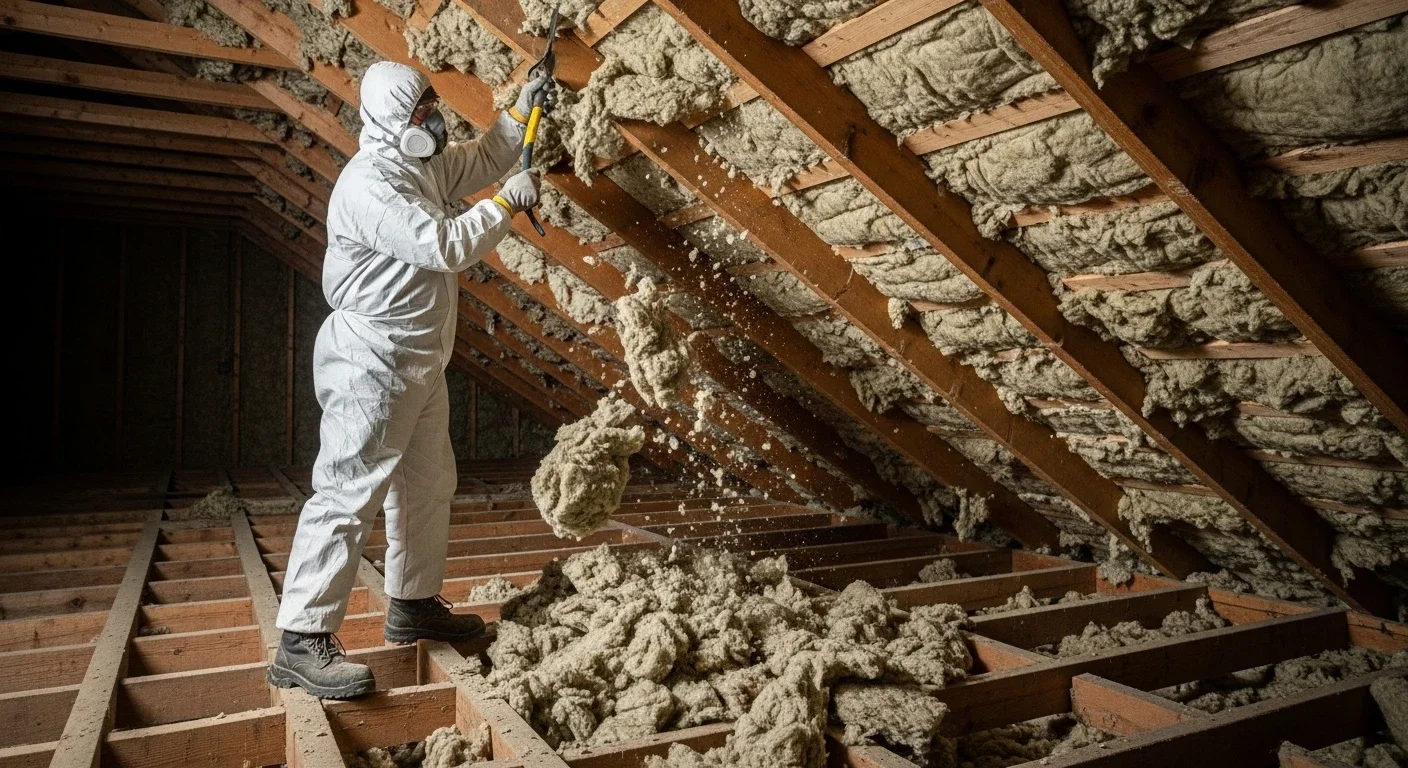
If your home’s insulation has become a liability rather than a benefit, it may be time for a clean slate. We provide professional insulation removal in Georgetown, TX, to help homeowners address issues like heavy settling, water damage, and contamination.
Removal becomes necessary when insulation can no longer perform its job. Simply adding new material over damaged, wet, or pest-contaminated insulation often masks underlying problems, leading to future energy loss and recurring indoor air quality issues.
You generally do not need to remove old insulation in Georgetown just because it is aging. If the material is clean, dry, and has not been disturbed, it may still provide value. However, several conditions make removal the only logical choice to protect your home.
Pest Contamination: If rodents or insects have nested in your insulation, they leave behind droppings and urine. These materials can harbor pathogens and release persistent, unpleasant odors into your living space.
Moisture and Mold: Insulation that has been soaked by roof leaks or high condensation levels often loses its structural integrity. Once insulation is saturated, it becomes a prime environment for mold growth, which can lower your indoor air quality.
Significant Settling: Over time, certain types of blown-in insulation can settle, losing the thickness required to reach its intended R-value. If the material has lost more than 20% of its original depth, it is often more effective to remove the compromised layer and start fresh.
Georgetown experiences a humid subtropical climate, which creates specific challenges for your home’s thermal envelope. According to historical data from the National Weather Service, summer temperatures frequently climb above 95°F, while the region maintains significant seasonal humidity. This combination creates a constant thermal and moisture stress test for your home.
Because of this heat and humidity, insulation in our area is constantly working against moisture migration. When your insulation is contaminated or saturated, it fails to resist heat transfer effectively, forcing your HVAC system to run longer to maintain a comfortable temperature. By removing compromised material, we clear out the moisture-trapping hazards and prepare your home for a high-performance system that can better withstand Central Texas weather.
Some homeowners consider removing insulation themselves to save on labor costs. We strongly advise against this. Insulation removal often involves navigating tight, poorly ventilated spaces filled with hidden hazards that require specialized equipment to manage.
Without industrial-grade, HEPA-filtered vacuum systems that exhaust directly to the exterior, you risk spreading dust, fiberglass particles, and rodent-borne pathogens throughout your home. Furthermore, walking across joists without proper training often leads to accidental damage to ceiling drywall or HVAC ductwork, which can turn a simple cleaning job into a costly repair project.
Removing old insulation is only the first step toward a more efficient home. The most important phase often happens after the old material is gone: air sealing.
Insulation is designed to slow the transfer of heat, but it does not stop the movement of air. Small gaps around light fixtures, plumbing stacks, and electrical wires allow conditioned air to escape, while letting outside air and humidity leak in. According to the U.S. Department of Energy, sealing these leaks is one of the most cost-effective ways to improve your home’s energy efficiency. We focus on air sealing as a standard practice because it addresses the source of drafts and high energy usage that insulation alone cannot solve.
Your insulation should contribute to your home’s comfort, not detract from it. If you suspect your material is doing more harm than good, do not wait for the problem to escalate into a costly repair or a health hazard.
We offer site-specific evaluations to determine whether you need a full removal or a targeted upgrade. Our approach centers on building science to ensure your home remains efficient throughout the intense Texas summer. Contact Spray Foam Tech today at (737) 777-9590 to schedule an assessment.
Yes, if the insulation has become a collection point for dust, mold spores, and pest waste. Removing these contaminants can lead to a noticeable improvement in your indoor air quality.
For an average Georgetown home, removal and site preparation typically take one to two days. The exact duration depends on the square footage and the type of material being removed.
While you do not necessarily need to leave, we recommend staying out of the immediate work area for safety. Our team uses specialized equipment to keep the living space clean, but the work process can be disruptive.
Open-cell foam is excellent for sound dampening and fills tight cavities, while closed-cell foam provides a higher R-value per inch and acts as a superior moisture barrier. You can review the benefits of these materials in our Building Science Guidance resources.
Do not touch or disturb it. Asbestos is a serious health hazard when fibers become airborne. We have the training and specialized equipment to handle suspected hazardous materials safely.
National Weather Service - Provided historical climate data and regional weather patterns for Central Texas.
U.S. Department of Energy - Provided guidance on the role of air sealing in home energy efficiency.