Spray Foam Roofing vs. Acrylic Roof Coating in Georgetown, TX: Key Differences Explained
Spray foam roofing and acrylic roof coating both protect flat and low-slope roofs in Georgetown, TX, but they solve different…


HFO blowing agents represent a major step forward for spray foam insulation, cutting the global warming potential of foam by over 99% compared to older HFC-based formulations. Builders, architects, and homeowners now have a way to get the air sealing, moisture resistance, and thermal performance of closed-cell spray foam without the environmental tradeoff that made traditional foam controversial. The right solution depends on your project type, climate zone, and whether you need the vapor retarder properties of closed-cell or the sound-dampening flexibility of open-cell. We use HFO-based spray foam to deliver that balance of performance and responsibility for every project we take on.
The blowing agent is the gas that expands liquid polyurethane into foam. It creates the tiny cellular structure that traps air and provides thermal resistance. For decades, the industry relied on hydrofluorocarbons (HFCs) as the primary physical blowing agent in closed-cell formulations. These HFC agents produced excellent foam, but they carried a serious environmental downside: a GWP measured in the hundreds or even thousands of times greater than carbon dioxide.
Hydrofluoroolefins (HFOs) work differently at the molecular level. As Wikipedia’s entry on hydrofluoroolefins explains, HFOs contain at least one carbon-carbon double bond that makes them highly reactive in the atmosphere. This reactivity gives them extremely short atmospheric lifetimes, which is why their GWP is so low. They break down rapidly before they can accumulate and contribute to atmospheric warming, unlike their HFC predecessors, which persist for decades.
The EPA’s page on understanding global warming potentials defines GWP as a measure of how much energy the emission of one ton of a gas will absorb over a given period, relative to one ton of CO2. Carbon dioxide serves as the baseline reference with a GWP of 1. By that standard, HFO blowing agents with a GWP of 1 are essentially on par with CO2 itself, which is a dramatic improvement over HFC agents with GWPs in the thousands.
The evolution of spray foam insulation chemistry tells a clear story of environmental progress. According to the Spray Foam Magazine article on the evolution of blowing agents, the industry has moved through four distinct generations:
| Generation | Blowing Agent | GWP Range | ODP | Status |
|---|---|---|---|---|
| First | CFCs | Over 4,000 | 1.0 | Banned in 1996 |
| Second | HCFCs | Over 700 | 0.11 | Banned in 2005 |
| Third | HFCs | 950 to 3,400+ | 0 | Phase-out underway |
| Fourth | HFOs | Less than 2 | 0 | Current standard |
The first generation, chlorofluorocarbons (CFCs), were banned under the Montreal Protocol after scientists confirmed their role in ozone layer destruction. HCFCs replaced them but still carried measurable ozone depletion potential. HFCs solved the ozone problem but introduced a new concern: their extremely high GWP meant they were potent greenhouse gases. HFOs, the current fourth generation, finally resolve both issues with zero ODP and near-zero GWP.
The shift to HFO blowing agents is not just an environmental story. These newer formulations also deliver measurable performance improvements over their HFC predecessors. As covered by Green Building Advisor’s reporting on next-generation spray foams, HFO-blown closed-cell foam achieves R-values of 6.3 per inch at a 2-inch thickness and up to 7.4 per inch at 8 inches.
Beyond thermal performance, HFO spray foam offers practical installation benefits:
Spray polyurethane foam stands apart from other insulation types because it serves multiple functions simultaneously. According to the American Chemistry Council’s Spray Foam Coalition, SPF insulation delivers three core benefits in a single application:
| Foam Type | R-Value per Inch | Air Barrier | Vapor Retarder |
|---|---|---|---|
| Open Cell | 3.6 to 4.5 | Yes | No |
| Closed Cell | 5.8 to 6.8 | Yes | Class II |
| Roofing SPF | 5.8 to 6.8 | Yes | Yes |
The air sealing capability of spray foam is particularly significant. Air leakage accounts for a substantial portion of energy loss in most buildings. When spray foam adheres to framing, sheathing, and studs, it creates a continuous seal that blocks air movement through gaps, cracks, and penetrations where fiberglass batts or blown cellulose simply cannot reach.
Closed-cell spray foam also qualifies as a Class II vapor retarder under the International Residential Code, which means it limits moisture transmission through wall and roof assemblies. This dual function of insulation plus vapor control is difficult to replicate with other materials without adding separate vapor barrier layers.
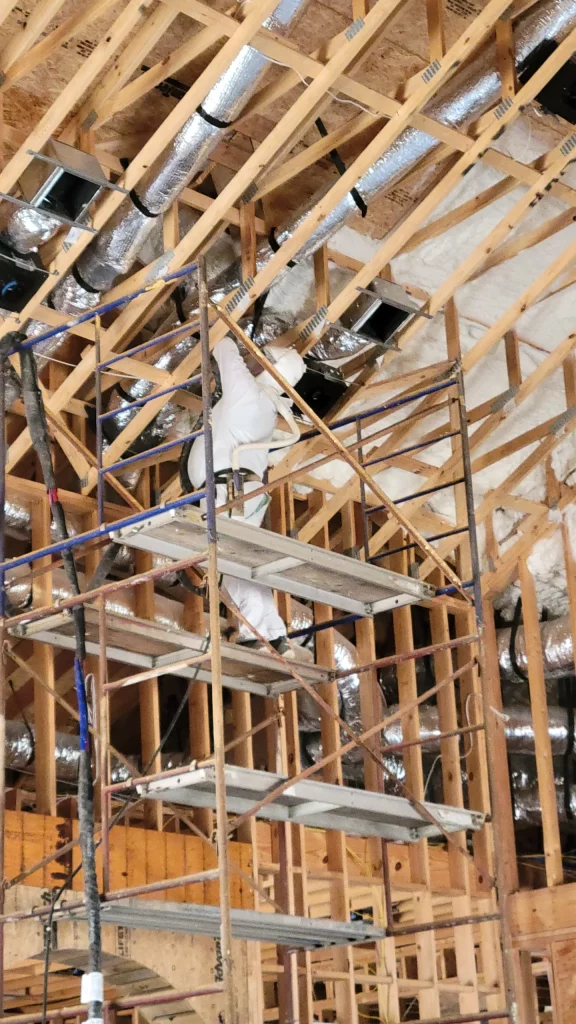
Not every project needs the same insulation approach. Here is how HFO spray foam fits different building scenarios:
New Construction Residential: Closed-cell HFO spray foam works well in wall cavities where space is limited and high R-value per inch matters. It also excels at the rim joist, band joist, and crawlspace ceilings, where air sealing and moisture control are both critical. Open-cell HFO foam is a strong choice for interior wall assemblies and attic floors where sound dampening and flexibility are priorities.
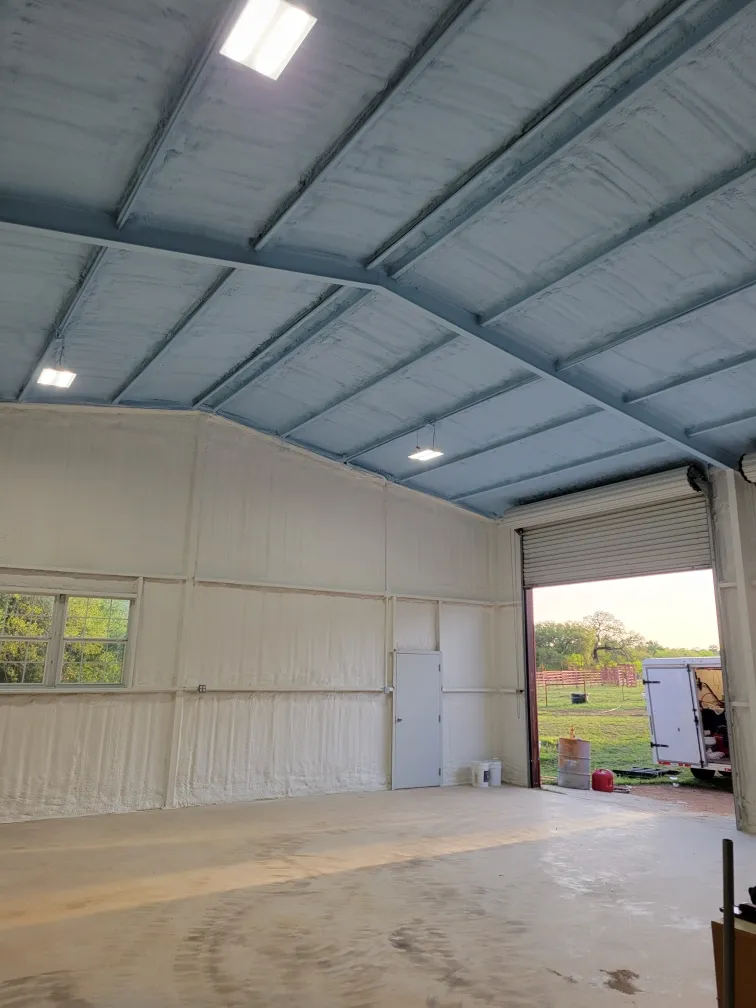
Commercial Buildings: HFO closed-cell spray foam is well-suited to metal building insulation, roof assemblies, and warehouse walls where the combination of thermal performance, air barrier continuity, and condensation control delivers real value over the life of the building.
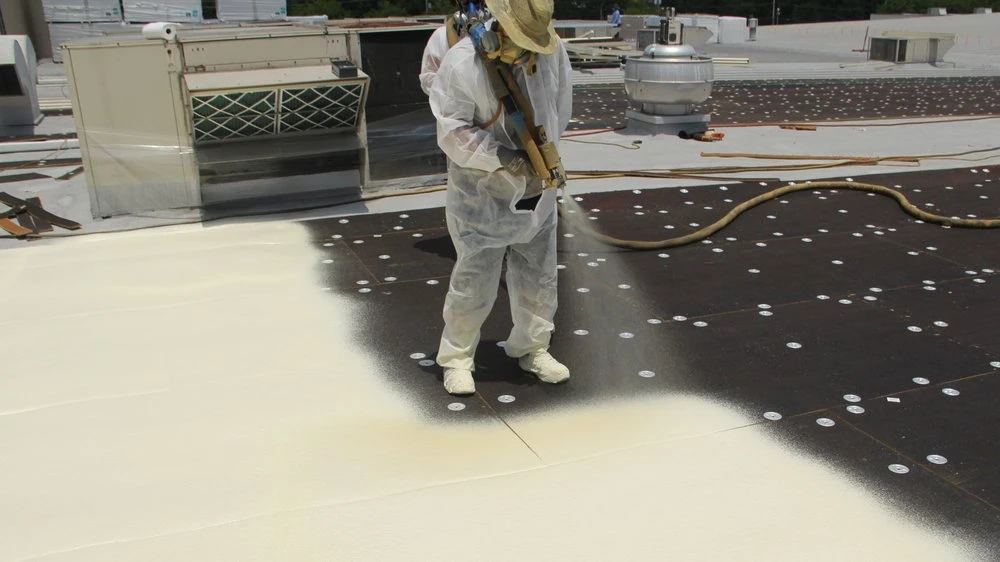
Retrofit and Renovation: Spray foam insulation is especially effective in existing buildings where cavity depths are shallow or framing irregularities make it difficult to fit rigid insulation boards. Our crews spray directly onto existing surfaces, conforming to uneven substrates and sealing gaps that other insulation types leave open.
Green Building and LEED Projects: HFO-based foam formulations help projects earn points under LEED and other certification programs due to their low GWP, reduced environmental impact, and contribution to overall building energy performance.
Choosing a contractor who understands HFO technology matters as much as choosing the right formulation. Look for these indicators:
At Spray Foam Tech, our team specializes in HFO-based spray foam insulation solutions that deliver superior thermal performance while meeting the latest environmental standards. Whether you are building new, retrofitting an existing structure, or pursuing green building certification, we have the experience and product knowledge to match the right foam system to your project. Contact us today at (737) 777-9590 or email oldworldtx@hotmail.com to discuss your insulation needs.
Q: What makes HFO blowing agents different from HFC blowing agents?
A: HFOs contain a carbon-carbon double bond that makes them break down rapidly in the atmosphere, giving them a GWP of 1 compared to HFCs that range from 950 to over 3,400.
Q: Can HFO spray foam be used in both open-cell and closed-cell applications?
A: Yes, HFO blowing agents are used primarily in closed-cell formulations, while open-cell spray foams typically use water-based chemical blowing agents that were already low in GWP.
Q: Does switching to HFO spray foam affect installation time?
A: HFO foam can be applied in lifts up to 6.5 inches per pass compared to roughly 2 inches for HFC foam, which can reduce the total number of passes needed on a project.
Q: Is HFO spray foam compliant with green building certification programs?
A: HFO-based formulations meet the criteria for LEED and other green building certifications due to their low GWP and contribution to improved building envelope performance.
Q: Are HFO blowing agents safe for indoor applications?
A: HFOs are classified as non-flammable, non-ozone-depleting, and are not considered VOCs by the EPA, making them suitable for residential and commercial interior use when properly applied.