Spray Foam Roofing vs. Acrylic Roof Coating in Georgetown, TX: Key Differences Explained
Spray foam roofing and acrylic roof coating both protect flat and low-slope roofs in Georgetown, TX, but they solve different…


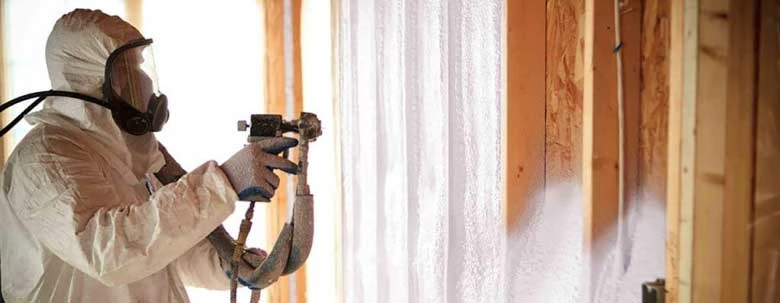
When it comes to closed-cell spray foam insulation applications, thickness is not just about hitting an R-value target. It directly determines whether the material can function as an effective vapor retarder. Apply too little, and you get insulation without meaningful moisture protection. Apply the correct thickness to create a continuous barrier that resists vapor diffusion, blocks air leakage, and prevents condensation within wall and ceiling assemblies.
For contractors and specifiers working in climate zones where moisture control is critical, understanding the relationship between closed-cell foam thickness and perm ratings is essential. This guide breaks down exactly how thickness affects moisture resistance, which minimum thicknesses meet code requirements, and how to apply this knowledge to specific building assemblies.
Water vapor moves through building materials by diffusion, traveling from areas of higher vapor pressure to areas of lower vapor pressure. The rate at which any material allows this movement is measured by its perm rating. A lower perm rating means stronger resistance to vapor transmission.
Closed-cell spray foam achieves its vapor-resistant properties from its cell structure. With over 90% of cells remaining closed after installation, the foam traps insulating gases within each cell and prevents air or water vapor from passing between them. This closed-cell structure gives closed-cell foam its characteristic density, rigidity, and resistance to moisture penetration.
However, the perm rating of closed-cell foam is not fixed. It depends on the thickness. According to the U.S. Department of Energy’s Building America program, closed-cell spray foam applied at 2 inches thick achieves a perm rating below 1.0, qualifying it as a vapor retarder. The same foam applied at only 1 inch might rate at 1.25 perms, which exceeds the Class II threshold.
This relationship exists because vapor must travel through more material to reach the opposite side. As thickness increases, the path length for vapor diffusion extends, and the effective permeance drops proportionally. Industry technical documents describe this as a linear relationship: doubling the thickness roughly halves the perm rating.
Building codes recognize three classes of vapor retarders based on perm ratings:
| Vapor Retarder Class | Perm Rating | Common Materials | Closed-Cell Foam Thickness |
|---|---|---|---|
| Class I | 0.1 or less | Polyethylene sheeting, aluminum foil | 3.0+ inches |
| Class II | 0.1 to 1.0 | Kraft-faced fiberglass, vapor retarder paint | 1.5 to 2.0 inches |
| Class III | 1.0 to 10 | Latex paint, standard paints | ~1.0 inch or less |
For most residential applications, a Class II vapor retarder is the minimum requirement. This means closed-cell spray foam must be applied at approximately 1.5 to 2 inches to meet code in climate zones 5 through 8 and Marine 4, where the International Residential Code mandates vapor retarders on the interior side of frame walls.
Research from Building Science Corporation indicates that closed-cell foam applied in thicknesses exceeding 2 inches will control vapor diffusion to safe levels in all climates up to 10,000 heating degree days, with interior winter relative humidities up to and exceeding 50%. As thickness increases beyond this minimum, the level of diffusion control increases proportionally.
The required thickness for effective moisture resistance varies depending on where the foam is installed and what climate conditions the assembly will face.
In cold climates (zones 5 through 8), vapor drive pushes moist indoor air outward through wall cavities. Without adequate vapor resistance at the exterior sheathing, this moisture can condense on cold surfaces and cause wood decay, mold growth, and insulation degradation.
For exterior wall applications in these climates, closed-cell foam should be applied at a minimum of 2 inches against the sheathing. Some hybrid assemblies use 1.5 inches of closed-cell foam against the sheathing, combined with batt insulation filling the remaining cavity. At 1.5 inches, the foam achieves approximately 0.83 perms, which meets Class II requirements but leaves less margin for extreme conditions.
In regions with more than 6,000 heating degree days, the minimum should be increased to 2 inches or more. This additional thickness ensures that even during extended cold periods, the interior surface of the foam remains above the dew point temperature, preventing condensation from forming within the wall cavity.
Below-grade applications present unique moisture challenges because ground moisture can saturate surrounding soil and migrate through foundation walls. Closed-cell spray foam is the preferred insulation choice for basements precisely because it resists both vapor diffusion and bulk water penetration when applied at sufficient thickness.
For basement walls, a minimum of 2 inches of closed-cell spray foam applied directly against the foundation concrete provides both insulation and vapor control. The foam must be covered with an approved thermal barrier such as drywall in habitable spaces, or an ignition barrier in non-habitable areas. Huntsman Building Solutions recommends that closed-cell foam used in below-grade applications be applied at sufficient thickness to achieve a perm rating of 1.0 or less, with typical minimums ranging from 1 to 2 inches,s depending on the specific product.
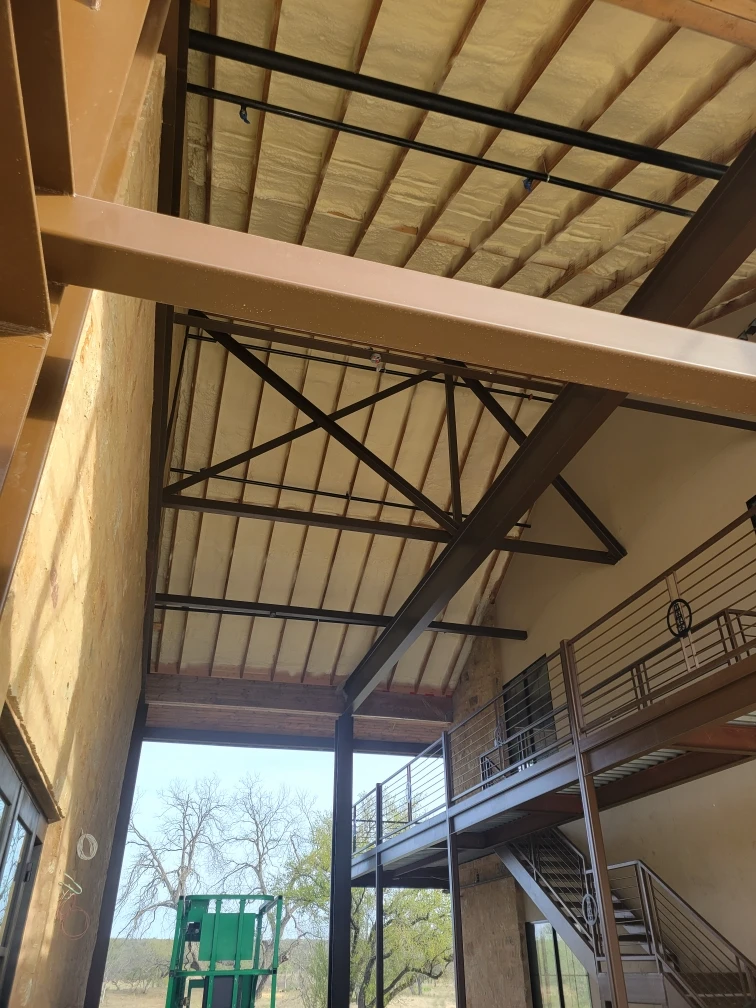
In roof deck applications, closed-cell foam is typically sprayed directly to the underside of the roof sheathing. This creates an unvented attic condition where the foam provides insulation, air sealing, and vapor control simultaneously.
For cathedral ceilings and roof decks, closed-cell spray foam should be applied at a minimum of 2 inches to achieve effective vapor control. In cold climates, this thickness prevents condensation on the interior surface of the roof sheathing during winter months. The foam also adds structural rigidity to the roof assembly, improving wind resistance and racking strength.
Rim joists are notorious thermal bridges and air leakage points. They also present moisture risks because they connect conditioned interior spaces with unconditioned cavities where temperature differentials can cause condensation.
Closed-cell spray foam works effectively at rim joist locations even in thin applications because the total area is relatively small. A minimum of 1.5 to 2 inches is recommended to ensure vapor control and air sealing at these critical junctions.
Understanding how to estimate vapor permeance based on thickness helps contractors make informed decisions when code requirements or design specifications change.
Most closed-cell foam products are tested to determine their permeance at a standard 1-inch thickness. Once you know this value, you can estimate the permeance at any applied thickness using the following relationship:
Estimated Perm Rating at Applied Thickness = (Perm Rating at 1″) / (Applied Thickness in Inches)
For example, if a specific closed-cell foam product has a permeance of 1.25 perms at 1 inch:
| Applied Thickness | Estimated Perm Rating |
|---|---|
| 1.0 inch | 1.25 |
| 1.5 inches | 0.83 |
| 2.0 inches | 0.63 |
| 3.0 inches | 0.42 |
| 4.0 inches | 0.31 |
This calculation demonstrates why 2 inches is often cited as the minimum for vapor retarder classification. At this thickness, most closed-cell products fall below the 1.0 perm threshold.
Achieving proper vapor resistance requires more than hitting a thickness number. Several installation errors can undermine moisture protection even when the foam appears to be applied correctly.
Gaps, low-density areas, and thin spots create pathways for vapor to bypass the intended retarder layer. When foam is applied too thinly or unevenly, the effective perm rating of the assembly increases, potentially allowing condensation to form in vulnerable areas.
Corners and edges of wall cavities are often difficult to fill completely. These areas may end up with insufficient foam thickness even when the center of the cavity is properly filled. Careful application technique and quality inspection are essential to ensure uniform coverage throughout the entire assembly.
Closed-cell spray foam expands during curing. If the foam is applied too thickly in a single pass without allowing for expansion, the cured foam may have voids or low-density areas that compromise vapor resistance. Product-specific installation guidelines typically specify maximum pass thickness, often 2 to 3 inches per pass for closed-cell formulations.
Vapor control depends on the entire assembly, not just the foam. Interior finishes, exterior sheathing, and cladding all affect how moisture moves through the building envelope. Closed-cell foam applied against the interior side of exterior sheathing acts as a vapor retarder for the wall cavity, but the exterior surface materials must allow drying to the outside to prevent moisture accumulation behind the foam.
Contractors and building owners can evaluate whether closed-cell foam applications will provide adequate moisture resistance by checking for several indicators.
The foam should be applied continuously with no visible gaps, voids, or thin spots when viewed from the side or ends. When cut or probed, the foam should exhibit a consistent, uniform cell structure without soft areas or compression.
For code compliance, documentation from the foam manufacturer should confirm that the specific product, when applied at the specified thickness, achieves a perm rating of 1.0 or less. This information is typically provided in the product’s evaluation service report or technical data sheet.
In finished assemblies, signs of moisture problems such as staining, mold growth, musty odors, or condensation on interior surfaces indicate that vapor control may be inadequate or that other assembly conditions are contributing to moisture accumulation.
Not every project requires the same thickness of closed-cell foam. The appropriate thickness depends on the specific application, climate conditions, and performance goals.
For projects where vapor control is the primary concern, such as below-grade applications or exterior walls in cold climates, a minimum thickness of 2 inches provides reliable Class II vapor retarder performance with margin for extreme conditions.
For hybrid systems combining closed-cell foam with other insulation types, thinner applications may be appropriate when the foam is placed as a continuous layer against the sheathing. A “flash and batt” approach using 1.5 to 2 inches of closed-cell foam against the sheathing with batt insulation filling the cavity can achieve adequate vapor control while optimizing cost and thermal performance.
In hot-humid climates, vapor drive reverses direction, pushing moisture from outside to inside. Closed-cell foam still provides benefits, but interior vapor retarders must be avoided to prevent trapping moisture within the wall cavity. The foam’s primary role in these climates is air sealing and thermal insulation rather than vapor control.
Thickness is the primary variable that contractors and specifiers control when using closed-cell spray foam for moisture resistance. A minimum of 1.5 to 2 inches is required for most products to achieve Class II vapor retarder performance. Greater thickness provides proportionally better vapor resistance and additional safety margins for extreme conditions.
The relationship between thickness and perm rating is predictable and calculable, allowing contractors to select the appropriate thickness based on product performance data, climate conditions, and building code requirements. However, thickness alone does not guarantee vapor resistance; application quality, uniform coverage, and proper integration with adjacent assembly components are equally important.
Our professionals have the expertise to evaluate your specific application and recommend the optimal closed-cell foam thickness for your moisture control needs. Whether you are insulating a basement, sealing a roof deck, or insulating exterior walls in a cold climate, we can help you get the thickness right the first time.
Spray Foam Tech specializes in closed-cell spray foam applications designed to meet vapor retarder requirements for a wide range of building assemblies. Our experienced technicians understand how thickness impacts moisture resistance and ensure every application meets performance standards.
Ready to discuss your project? Reach out for a quote or request a consultation to learn how proper closed-cell foam thickness can protect your building from moisture damage.
Contact details:
Phone: (737) 777-9590
email: oldworldtx@hotmail.com
Applying too little foam results in insulation without meaningful moisture protection, as it may not reach the perm rating required for a Class II vapor retarder.
The estimated perm rating at an applied thickness is found by dividing the 1-inch perm rating by the applied thickness in inches.
Its primary role is air sealing and thermal insulation, and interior vapor retarders should be avoided to prevent trapping moisture within the wall cavity.
A minimum of 2 inches is recommended to achieve effective vapor control and prevent condensation on the interior surface of the roof sheathing.
Over 90% of the cells remain closed, trapping insulating gases and preventing the passage of air or water vapor from passing between them.