Spray Foam Roofing vs. Acrylic Roof Coating in Georgetown, TX: Key Differences Explained
Spray foam roofing and acrylic roof coating both protect flat and low-slope roofs in Georgetown, TX, but they solve different…


Closed-cell spray foam delivers long-term thermal performance by combining a high R-value per inch with superior air sealing and moisture resistance in a single application. For homeowners and builders looking to reduce energy consumption, the choice between insulation types depends on climate zone, building design, and whether the project involves new construction or retrofitting an existing structure. Closed-cell spray foam insulation works for homeowners seeking maximum thermal resistance in limited cavities, builders working with challenging wall designs where air infiltration is a concern, and anyone dealing with moisture-prone environments like crawlspaces and basements.
The R-value measures how effectively a material resists conductive heat flow, and according to Wikipedia’s R-value (insulation) article, closed-cell polyurethane spray foam achieves R-5.5 to R-6.5 per inch of thickness. By comparison, fiberglass batts and blown cellulose deliver roughly R-2.5 to R-4 per inch. When wall cavities, attic rafters, or rim joists have limited depth, the material with the higher per-inch R-value produces a higher total R-value in the same space.
This matters because many retrofit situations involve constrained cavities. A standard 2×4 stud bay is 3.5 inches deep. Fiberglass at R-3.1 per inch fills that cavity with roughly R-11 total. Closed-cell spray foam in the same space delivers approximately R-19 to R-23. The difference compounds over decades of heating and cooling cycles.
The ENERGY STAR recommended insulation R-values show that climate zones 4 through 8 call for R-49 to R-60 in attics and R-13 to R-30 for wall cavities. In many homes, reaching these targets without closed-cell spray foam would require building out walls or adding continuous exterior insulation, both of which add complexity and expense.
R-value alone does not capture the full picture of thermal performance. The Building insulation article on Wikipedia explains that heat transfers through conduction, convection, and radiation. Fibrous insulations like fiberglass and cellulose resist conduction well but do little to stop convective heat loss through air leaks around studs, pipes, electrical boxes, and framing gaps.
Closed-cell spray foam expands on application to fill gaps, cracks, and voids, creating an airtight seal against the substrate. This eliminates the air infiltration that accounts for a significant portion of energy loss in poorly sealed buildings. The R-value article from Wikipedia notes that one of the primary values of spray foam insulation is its ability to create an airtight seal directly against the substrate to reduce the undesirable effects of air leakage.
In practical terms, a home insulated with R-19 fiberglass in the walls but with unsealed penetrations may perform worse than a home insulated with R-13 closed-cell spray foam that is fully air sealed. The air sealing component is what allows closed-cell spray foam to deliver real-world thermal performance that consistently meets or exceeds its rated R-value in actual conditions.
Moisture is one of the most damaging factors for insulation performance. The Building Science Corporation’s BSD-106 digest on vapor barriers describes how moisture control in building assemblies directly affects both durability and thermal performance. When fibrous insulation absorbs moisture, its thermal conductivity increases, meaning it loses insulating effectiveness.
Closed-cell spray foam resists moisture absorption because its cell structure is filled with a blowing agent rather than air. This gives it a low water absorption rate and makes it function as a vapor semi-impermeable barrier (Class II vapor retarder, rated at 1.0 perm or less). In the Building Science Corporation’s wall assembly recommendations, spray foam is specifically noted as a non-moisture-sensitive insulation that allows walls to dry inward, making it suitable for all hygro-thermal regions when applied correctly.
The long-term stability of closed-cell spray foam also matters. Unlike fiberglass batts that can sag, settle, or be displaced by rodents and pests, closed-cell spray foam adheres permanently to the substrate and maintains its shape and position throughout the life of the building. There is no settling, no gaps opening up over time, and no compression from stacked materials in attics.
The R-value (insulation) article covers an important nuance: some foam insulations, including closed-cell spray polyurethane, can experience a gradual reduction in R-value over time as the blowing agents within the closed cells slowly diffuse out and are partially replaced by air. This is a known behavior for foam products that use high-performance blowing gases.
To address this, the foam insulation industry adopted the Long-Term Thermal Resistance (LTTR) method, which rates R-value based on a 15-year weighted average. The LTTR effectively provides an eight-year aged R-value, giving a more realistic expectation of performance over the building’s life. While research from the U.S. Army Engineer Research and Development Center, cited in the R-value article, indicates that closed-cell polyurethane foam may experience some R-value reduction over extended timeframes, the material still retains significantly higher per-inch thermal resistance than most alternatives, even after aging.
| Insulation Type | R-Value Per Inch | Air Sealing | Moisture Resistance | Best Application |
|---|---|---|---|---|
| Closed-cell spray foam | R-5.5 to R-6.5 | Excellent, airtight seal | Low absorption, Class II vapor retarder | Walls, crawlspaces, rim joists, metal buildings |
| Open-cell spray foam | R-3.6 to R-3.7 | Excellent, airtight seal | High absorption, vapor permeable | Wall cavities, attics (where moisture drying is needed) |
| Fiberglass batts | R-3.1 to R-4.3 | Minimal air sealing | Absorbs moisture, loses R-value | Standard wall cavities, attics (cost-sensitive projects) |
| Cellulose (blown) | R-3.0 to R-3.8 | Moderate (dense-pack) | Absorbs moisture, can settle | Attics, existing wall cavities (retrofit) |
| Extruded polystyrene (XPS) | R-5.0 to R-5.4 | Seams need taping | Low absorption, varies by density | Continuous exterior insulation, below-grade |
| Polyisocyanurate | R-5.5 to R-6.8 | Seams need taping | Low absorption, foil-faced acts as vapor barrier | Roof assemblies, continuous exterior insulation |
Crawlspaces and basements. Ground-contact and below-grade environments present persistent moisture challenges. Closed-cell spray foam applied to rim joists, foundation walls, and crawlspaces provides both thermal insulation and a moisture-resistant barrier that fibrous products cannot match in these conditions.
Rim joists and band joists. These areas are notoriously difficult to insulate with batts because of irregular framing, plumbing, and electrical penetrations. Spray foam expands to fill every void, eliminating the air leaks that commonly occur at these transition points.
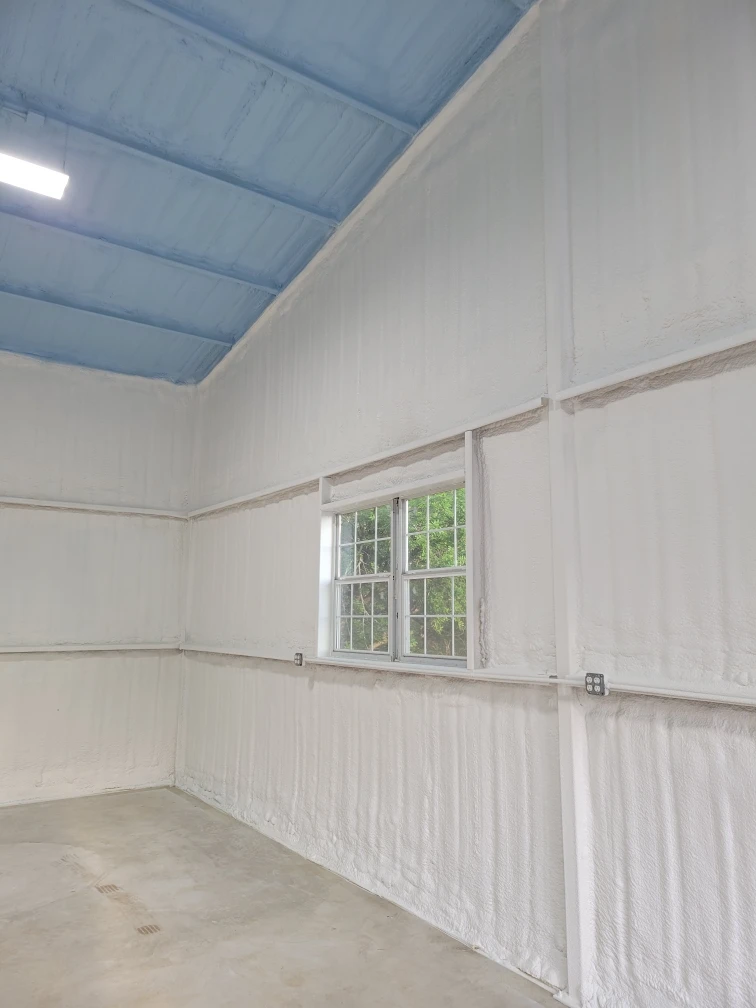
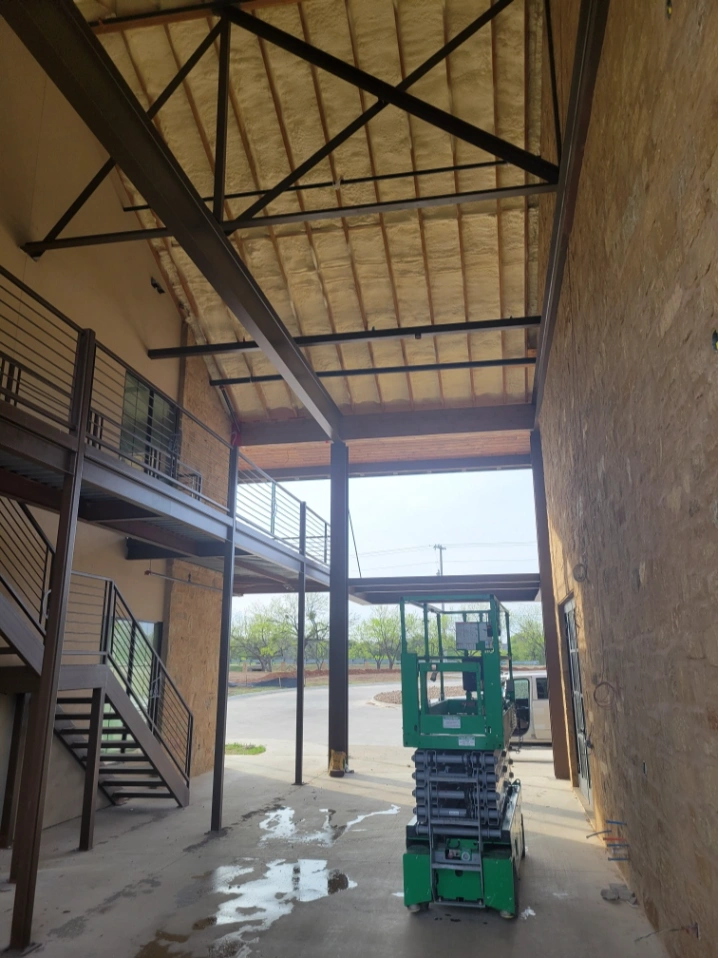
Metal buildings and pole barns. Structures with metal framing face extreme thermal bridging, where heat transfers rapidly through conductive metal members. Closed-cell spray foam applied to the interior creates a continuous thermal break and seals the numerous gaps inherent in metal construction.
Attic retrofits in humid climates. In hot-humid regions, moving the insulation boundary to the roof line (unvented attic) with closed-cell spray foam prevents moisture-laden air from reaching cooler surfaces where condensation would form. The vapor semi-impermeable nature of high-density spray foam manages this moisture drive effectively.
| Project / Audience | Recommended Approach | Key Notes |
|---|---|---|
| New construction, budget-sensitive | Hybrid approach: closed-cell foam in problem areas, fiberglass or cellulose in standard cavities | Minimizes material cost while addressing the most critical air leakage and moisture points |
| Existing home retrofit | Closed-cell spray foam in rim joists, crawlspace, and attic flat portions | Addresses the highest-priority leakage areas with minimal demolition |
| High-performance or net-zero builds | Full closed-cell spray foam in walls and roof assemblies, plus continuous exterior rigid insulation | Maximizes R-value in limited cavity depths and ensures airtightness |
| Metal building or pole barn | Closed-cell spray foam applied directly to metal framing and roof deck | Eliminates thermal bridging and seals inherent metal-to-metal gaps |
| Basement or crawlspace encapsulation | Closed-cell spray foam on walls and rim joists, combined with a sealed vapor barrier on the floor | Manages ground moisture while insulating the below-grade envelope |
Selecting the right installer has a direct impact on the long-term thermal performance of closed-cell spray foam. The FTC R-Value Rule requires insulation manufacturers, professional installers, and retailers to provide specific R-value disclosures based on standardized test results. A contractor who readily shares product R-values and test documentation demonstrates transparency.
Other indicators of a quality installation include a detailed scope of work that specifies the exact R-value target and spray foam thickness for each area of the building, a clear explanation of the difference between open-cell and closed-cell products and why one is recommended over the other for your specific project, discussion of ventilation requirements since tightly sealed homes need mechanical ventilation to maintain indoor air quality, and a warranty that covers both the product and the installation workmanship for an extended period.
Spray Foam Tech delivers expert closed-cell spray foam insulation that addresses thermal resistance, air sealing, and moisture management in a single application. Our team evaluates your building’s specific needs based on climate zone, construction type, and project goals to recommend the right approach for lasting results. Whether you need a full insulation upgrade or targeted air sealing in problem areas, we provide precise installation backed by product documentation and performance data.
Call us at (737) 777-9590 or email oldworldtx@hotmail.com to get started.
Yes, a gradual reduction can occur as blowing agents diffuse out of the cells, but the LTTR (Long-Term Thermal Resistance) rating accounts for this and provides a realistic 15-year weighted average for expected performance.
Closed-cell spray foam delivers both higher R-value per inch and air sealing that fiberglass cannot provide, which means it addresses conductive and convective heat loss simultaneously in a way that fiberglass alone does not.
In most cases, installing closed-cell spray foam in existing walls requires access to the stud cavities, which typically means removing exterior sheathing or interior drywall, though rim joists and crawlspaces are accessible without demolition.
Closed-cell spray foam functions as a Class II vapor retarder (1.0 perm or less), making it vapor semi-impermeable, which is suitable for most climate zones and building assemblies when applied correctly.
Tightly sealed buildings do require controlled mechanical ventilation to maintain indoor air quality, and this is a standard recommendation for any home with spray foam insulation installed to ensure proper fresh air exchange.